

Get timely analysis, firm updates, and strategic perspectives delivered straight to your inbox.
End-of-2026 Health Policy Landscape: What Congress Could Address Before Year-End
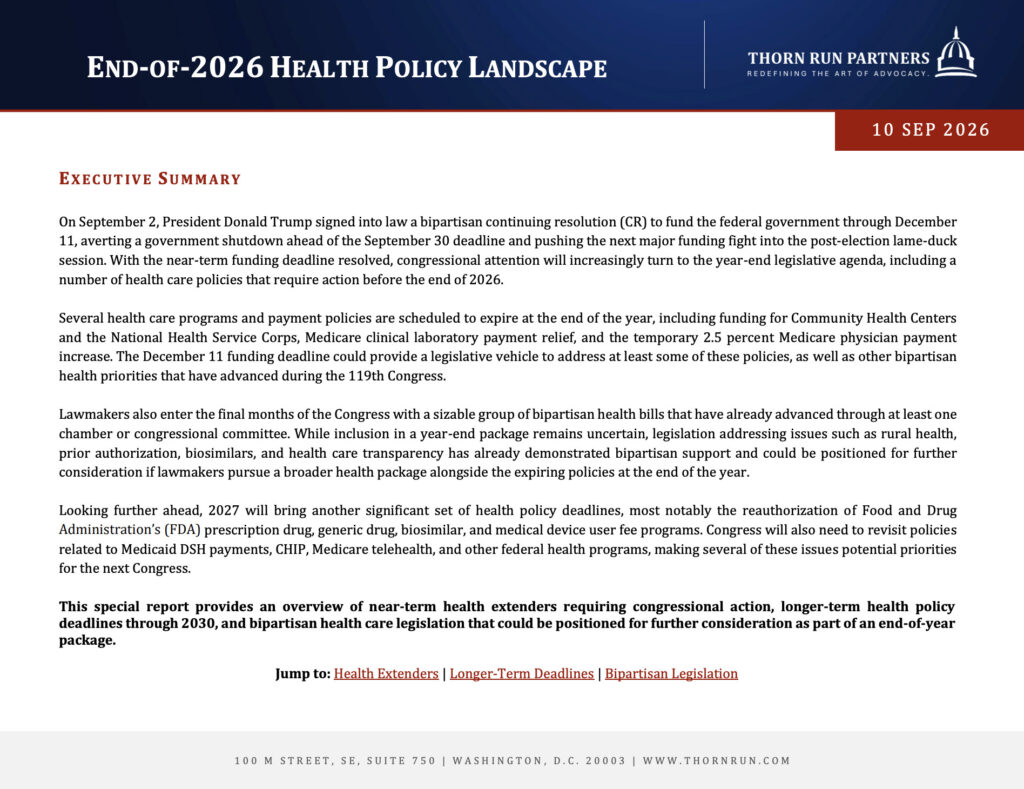
September 14, 2026With the near-term government funding deadline resolved, congressional attention is beginning to shift toward the year-end legislative agenda — including a significant number of health care policy issues requiring action before the end of 2026.
President Donald Trump signed a bipartisan continuing resolution on September 2 that funds the federal government through December 11. That deadline now creates a potential legislative vehicle for lawmakers to address several expiring health care programs and payment policies, while also opening the door for other bipartisan health priorities that have advanced during the 119th Congress.
Thorn Run Partners’ End-of-2026 Health Policy Landscape provides a forward-looking overview of the issues health care stakeholders should be watching as Congress approaches the final months of the year.
Key Health Care Policies Facing Year-End Deadlines
Several federal health programs and payment policies are scheduled to expire at the end of 2026, including funding for Community Health Centers and the National Health Service Corps, the Special Diabetes Program, Medicare clinical laboratory payment relief, and the temporary 2.5 percent Medicare physician payment increase.
Congress must also consider policies affecting rural hospitals, alternative payment models, implementation of the No Surprises Act, and other federal health programs. While many of these provisions have historically received bipartisan support, their timing and duration are often tied to broader negotiations over must-pass legislation.
A Potential Year-End Health Care Package
Beyond the expiring provisions, lawmakers enter the final months of the 119th Congress with a sizable group of bipartisan health bills that have already moved through at least one chamber or congressional committee.
The legislation spans issues including rural health, prior authorization, biosimilars, health care transparency, workforce programs, organ transplantation, telehealth, and disease-specific research and prevention initiatives.
Whether these measures ultimately become part of a broader year-end package remains uncertain. However, their bipartisan support and legislative progress could position some of them for further consideration if congressional leaders pursue a larger health care agreement alongside the expiring policies.
Looking Beyond 2026
The policy calendar will remain active well after the current Congress adjourns.
In 2027, lawmakers will face another significant set of health care deadlines, including reauthorization of the FDA’s prescription drug, generic drug, biosimilar, and medical device user fee programs, as well as policies related to Medicaid Disproportionate Share Hospital payments, CHIP, and Medicare telehealth.
Additional federal health programs carry expiration or reauthorization deadlines through 2030, making many of these issues potential priorities for the next Congress as well.
What’s in the Report
The full TRP special report includes:
- A detailed overview of health care extenders and other policies requiring congressional action
- A timeline of health policy expirations through 2030
- A review of bipartisan health care legislation that has advanced in Congress
- Current legislative status and, where available, Congressional Budget Office scores
- Key issues that could become candidates for a year-end or other must-pass legislative package
Thorn Run Partners continues to monitor congressional negotiations and legislative developments as lawmakers approach the December 11 funding deadline and the end of the 119th Congress.
Media inquiries: Daniel Gleason | dgleason@thornrun.com