One of America’s Fastest-Growing Lobbying Firms - Ranked by Bloomberg

What Sets a Top Federal Lobbying Firm Apart?

There are more than 1,000 federal lobbying firms in Washington, D.C., competing for attention, access, and influence. For organizations facing a government-related challenge—or spotting a federal opportunity—that sheer volume can make one question unavoidable:

How do you identify a top federal lobbying firm that can actually deliver results?

Despite political volatility, several realities about federal advocacy are indisputable:

  1. The federal government has never been more consequential for businesses, nonprofits, and institutions operating in the United States.
  2. Effective federal lobbying requires both access and expertise—one without the other rarely produces meaningful outcomes.
  3. Modern advocacy is multidimensional, combining direct lobbying, stakeholder engagement, and strategic communications.
  4. Long-term success in Washington depends on bipartisan credibility, not short-term political alignment.
  5. Lobbying is an investment, requiring time, resources, and sustained commitment to achieve lasting impact.

In short, what sets a top federal lobbying firm apart goes far beyond who they know on Capitol Hill. The most effective firms blend deep policy knowledge, bipartisan trust, strategic communications, and a relentless focus on measurable results.

A Bipartisan Foundation Is Non-Negotiable

At the core of any top federal lobbying firm is the ability to operate credibly across the political spectrum.

In an era of sharp polarization, bipartisan reach is not a “nice to have”—it is essential. Firms that maintain strong relationships with lawmakers and officials on both sides of the aisle are better positioned to advocate for clients regardless of which party controls Congress or the White House.

Bipartisan lobbying capabilities ensure continuity, durability, and influence through political cycles—protecting client priorities as power shifts.

Integrated Services Beyond Traditional Lobbying

Elite federal lobbying firms no longer operate as single-lane government relations shops.

What distinguishes the best firms is their ability to deliver integrated advocacy services, often combining:

  • Federal lobbying and government relations
  • In-depth policy analysis and legislative monitoring
  • Strategic communications and media engagement
  • Coalition and third-party stakeholder building
  • Grant strategy and federal funding support

This full-spectrum approach reflects how policy decisions are actually made. Direct lobbying may open doors, but shaping the narrative, mobilizing allies, and educating stakeholders are what drive sustained policy success.

Whether the objective is legislative change, regulatory reform, or securing federal funding, a coordinated strategy turns influence into impact.

Breadth and Depth of Policy Expertise

Another defining feature of a top federal lobbying firm is specialized expertise.

Rather than relying on generalists, leading firms invest in subject-matter experts who understand the technical, regulatory, and political nuances of their clients’ issues. This depth allows advocates to help craft policy solutions that are realistic, defensible, and more likely to succeed.

Top firms often maintain practice areas spanning:

  • Appropriations and federal funding
  • Health care and life sciences
  • Energy and environmental policy
  • Financial services and tax policy
  • National security and defense
  • Technology, infrastructure, and transportation

This breadth enables firms to serve diverse clients—from Fortune 500 companies to nonprofits and trade associations—while delivering issue-specific advocacy grounded in expertise, not just access.

Measurable Results and Proven Success

Access alone does not define success—outcomes do.

A top federal lobbying firm should be able to demonstrate a track record of tangible results, such as:

  • Legislation enacted or amended
  • Regulations shaped or blocked
  • Federal funding secured
  • Adverse policies mitigated

One practical way clients evaluate firms is through industry recognition and performance rankings from respected outlets. These acknowledgments reflect not only growth, but an ability to consistently deliver for clients.

Equally important is transparency. Leading firms define success metrics, track progress, and report clearly—so clients understand the return on their advocacy investment.

Deep Relationships With Federal Decision-Makers

Strong relationships remain a cornerstone of effective federal lobbying—but quality matters more than quantity.

Top firms employ professionals with decades of experience in Congress, executive agencies, and the broader federal policymaking ecosystem. These long-standing relationships are built on trust, credibility, and repeated engagement over time.

Crucially, elite firms also know how to deploy those relationships strategically—connecting clients with the right policymakers, engaging agencies during rulemaking, and navigating complex interagency dynamics.

Strategic Communications and Narrative Shaping

In today’s policy environment, influence extends beyond government offices into the public sphere.

Top federal lobbying firms integrate strategic communications into their advocacy efforts, helping clients shape narratives through:

  • Earned media and press engagement
  • Opinion pieces and thought leadership
  • Targeted messaging for policymakers and stakeholders

By aligning policy goals with communications strategy, firms help clients influence both decision-makers and public perception—transforming advocacy from transactional engagement into sustained influence.

Conclusion: Defining a Top Federal Lobbying Firm

Firms that consistently demonstrate these qualities—bipartisan credibility, integrated services, deep policy expertise, measurable results, trusted relationships, and strategic communications—are best positioned to deliver long-term value for their clients.

At Thorn Run Partners, these principles guide how we approach federal advocacy every day. Our bipartisan team, sector-specific expertise, and integrated government affairs and strategic communications capabilities enable us to help clients navigate Washington’s complexity and achieve durable policy outcomes across changing political environments.

Rural Health Transformation Fund (RHTF) Roadmap | State-by-State Funding Insights

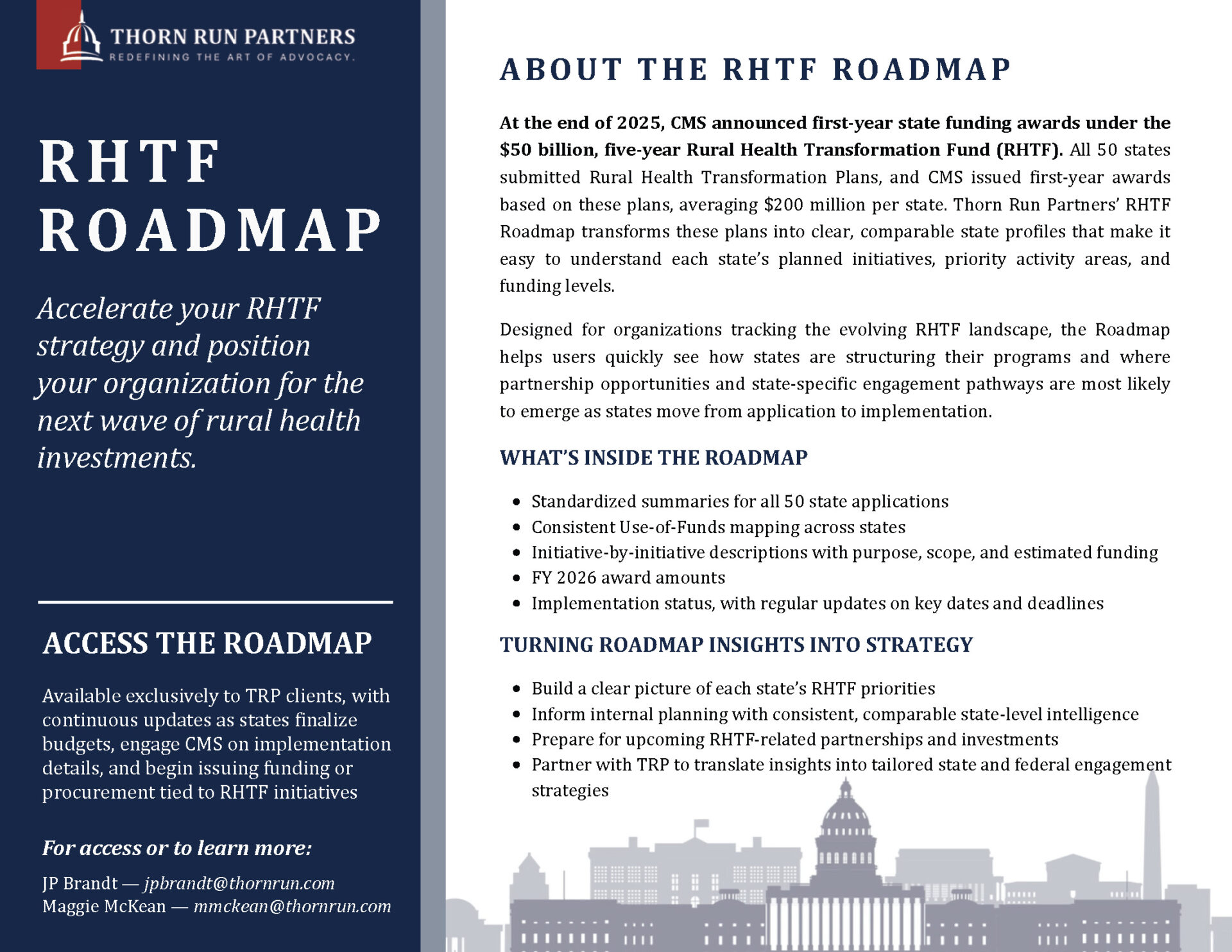
In late 2025, CMS announced the first-year awards under the $50 billion Rural Health Transformation Fund (RHTF) after reviewing plans submitted by all 50 states. With wide variation across state proposals and priority activity areas, Thorn Run Partners is focused on helping clients interpret award levels, anticipate near-term activity, and identify where partnership opportunities are most likely to emerge.

To help clients make sense of the emerging state landscape, TRP’s RHTF Roadmap provides a state-by-state toolkit that translates each application into a standardized profile of planned initiatives, priority activity areas, use-of-funds categories, and (now) FY 2026 award amounts.

Click here to download.

If you’re interested in how Thorn Run’s team of healthcare government affairs professionals can help you navigate this opportunity, contact TRP’s JP Brandt (jpbrandt@thornrun.com) and Maggie McKean (mmckean@thornrun.com) to learn more.

Choosing a Lobbyist in Washington, DC: A Strategic Guide for Organizations

In today’s complicated—but unavoidable—political landscape, companies and organizations increasingly recognize that strategic engagement with the federal government is essential. Whether the goal is influencing legislation, shaping regulatory policy, securing federal funding, or understanding the political environment, having the right lobbyist can mean the difference between success and stagnation.

Choosing a lobbyist in Washington, DC, is not a decision to be made lightly. It can be costly in terms of both dollars and time, and it requires evaluating not only technical capabilities, but also cultural fit, strategic insight, and long-term value.

Based on decades of experience working with hundreds of organizations navigating Washington, the recommendations below focus on attributes such as bipartisan experience, multidisciplinary expertise, client focus, and measurable outcomes to help guide a well-informed decision.

1. Define Your Strategic Goals Before Hiring a Lobbyist

Before beginning the search for a lobbying firm in Washington, DC, an organization must clarify why it needs representation:

  • Are you seeking to influence a specific piece of legislation?
  • Do you want to shape regulatory rulemaking at a federal agency such as the Department of Health and Human Services or the Department of Transportation?
  • Is federal funding or congressional appropriations part of the strategy?
  • Do you need crisis management or strategic communications support?

Understanding these objectives allows a company to align its needs with a government relations firm that has demonstrated experience in the relevant policy areas.

2. Prioritize Bipartisan Lobbying Capability

Washington’s political environment is inherently bipartisan. Even during periods of one-party control, legislative and regulatory outcomes require engagement across the aisle. A lobbying firm with strong, balanced relationships on both sides of the political spectrum is better positioned to deliver results over the long term.

Firms built around bipartisan leadership and experience are rare—but valuable. This structure allows them to engage policymakers regardless of party affiliation, providing a clear advantage for clients whose interests are not tied to a single political agenda.

This balanced approach enhances credibility on Capitol Hill and increases the likelihood that a client’s message will be heard by a broad range of decision-makers.

3. Evaluate Depth of Experience and Government Relationships

Lobbying remains, at its core, a people-driven business. Trust, credibility, and influence are often rooted in relationships developed over years of service on Capitol Hill or within federal agencies.

When evaluating potential lobbying firms, organizations should ask:

  • Do the firm’s principals have firsthand legislative or regulatory experience?

  • Has the team worked on significant policy initiatives or held senior government positions?

  • Can the firm leverage long-standing relationships with key congressional staff and agency officials?

Firms led by former congressional aides and government officials often bring both substantive policy insight and practical understanding of how federal institutions operate.

4. Look Beyond Traditional Lobbying to Integrated Government Affairs Services

While direct advocacy with members of Congress and federal agencies remains central to government relations, modern policy challenges often require a broader, integrated approach. This may include:

  • Policy analysis to anticipate legislative and regulatory developments

  • Strategic communications to shape public narratives

  • Coalition building to align stakeholders around shared objectives

  • Grant and appropriations support to secure federal funding

A full-service government affairs firm can integrate these capabilities into a cohesive strategy rather than treating them as isolated functions.

5. Demand Measurable Outcomes and Clear Performance Metrics

Too many lobbying engagements lack clearly defined success metrics. Organizations should seek a lobbying partner that:

  • Establishes clear objectives at the outset

  • Identifies measurable benchmarks for success

  • Provides regular, transparent reporting on progress

Prospective clients should request case studies or examples of tangible outcomes, as well as insight into how the firm evaluates and reports performance.

6. Assess Communication Style and Client Engagement

Effective advocacy depends on clear, proactive communication. A lobbyist must not only advocate on behalf of a client, but also ensure the client remains informed and prepared.

Key considerations include:

  • Frequency and clarity of legislative and regulatory updates

  • Responsiveness during fast-moving or unexpected developments

  • Willingness to tailor communication to the client’s needs and level of expertise

Firms with a strong client-service culture often provide curated briefings, issue trackers, and regular political intelligence summaries.

7. Consider Cultural Fit and Long-Term Partnership Potential

Government relations is rarely a short-term effort. Organizations should view their lobbying firm as a long-term strategic partner rather than a transactional service provider.

Indicators of strong cultural fit include:

  • Transparency in billing and strategy

  • A client-centric approach

  • A demonstrated understanding of the client’s mission, industry, and risk tolerance

8. Evaluate Reputation and Third-Party Recognition

Industry recognition and media coverage can offer valuable insight into a firm’s standing within Washington’s policy ecosystem. Rankings, peer recognition, and coverage by respected outlets such as POLITICO Influence can help validate a firm’s credibility and effectiveness.

While rankings alone should not determine a decision, they provide useful context when evaluating potential partners.

Making an Informed Choice in Washington

Selecting a lobbyist in Washington, DC is one of the most consequential decisions an organization can make when engaging with federal policy. The right firm becomes more than an advocate—it becomes a strategic partner capable of translating organizational goals into policy outcomes.

By clearly defining objectives, prioritizing bipartisan experience, demanding integrated services and measurable results, and assessing cultural fit, organizations can make informed decisions about their government relations strategy.

While no single lobbying firm is right for every organization, the criteria outlined above provide a practical framework for selecting a partner equipped to navigate Washington’s complex political environment effectively.