Top 10 Lobbying Firm - Ranked by Bloomberg

End-of-2026 Health Policy Landscape: What Congress Could Address Before Year-End

With the near-term government funding deadline resolved, congressional attention is beginning to shift toward the year-end legislative agenda — including a significant number of health care policy issues requiring action before the end of 2026.

President Donald Trump signed a bipartisan continuing resolution on September 2 that funds the federal government through December 11. That deadline now creates a potential legislative vehicle for lawmakers to address several expiring health care programs and payment policies, while also opening the door for other bipartisan health priorities that have advanced during the 119th Congress.

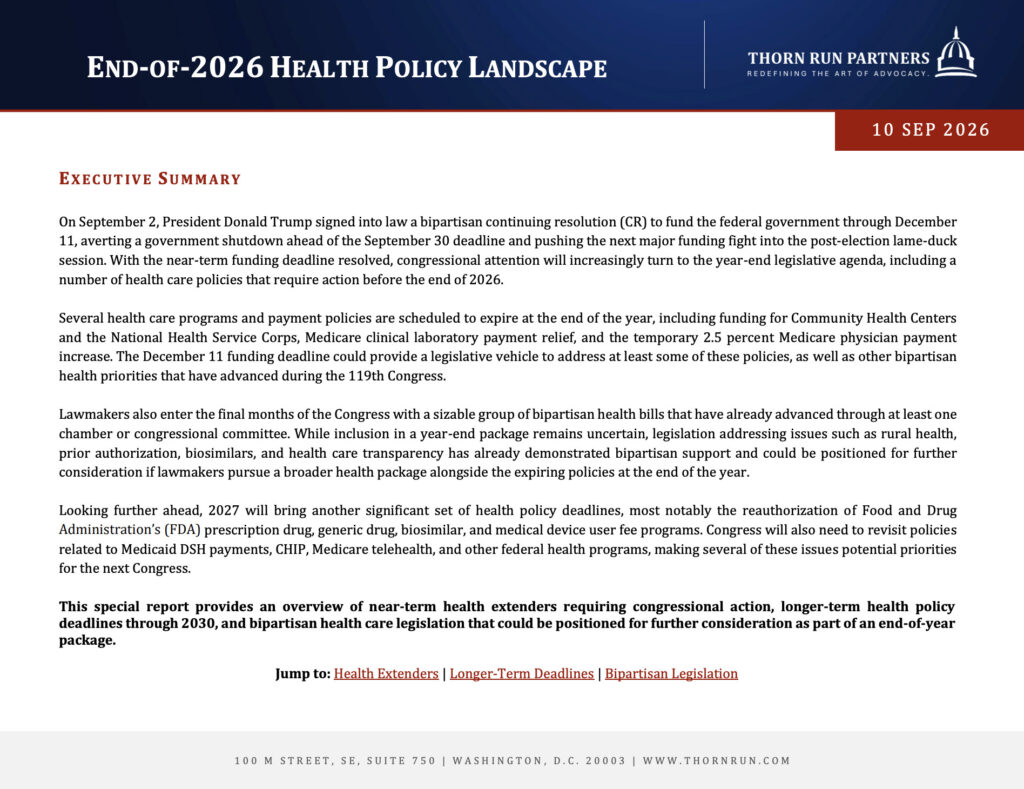
Thorn Run Partners’ End-of-2026 Health Policy Landscape provides a forward-looking overview of the issues health care stakeholders should be watching as Congress approaches the final months of the year.
Key Health Care Policies Facing Year-End Deadlines

Several federal health programs and payment policies are scheduled to expire at the end of 2026, including funding for Community Health Centers and the National Health Service Corps, the Special Diabetes Program, Medicare clinical laboratory payment relief, and the temporary 2.5 percent Medicare physician payment increase.

Congress must also consider policies affecting rural hospitals, alternative payment models, implementation of the No Surprises Act, and other federal health programs. While many of these provisions have historically received bipartisan support, their timing and duration are often tied to broader negotiations over must-pass legislation.

A Potential Year-End Health Care Package

Beyond the expiring provisions, lawmakers enter the final months of the 119th Congress with a sizable group of bipartisan health bills that have already moved through at least one chamber or congressional committee.

The legislation spans issues including rural health, prior authorization, biosimilars, health care transparency, workforce programs, organ transplantation, telehealth, and disease-specific research and prevention initiatives.

Whether these measures ultimately become part of a broader year-end package remains uncertain. However, their bipartisan support and legislative progress could position some of them for further consideration if congressional leaders pursue a larger health care agreement alongside the expiring policies.

Looking Beyond 2026

The policy calendar will remain active well after the current Congress adjourns.

In 2027, lawmakers will face another significant set of health care deadlines, including reauthorization of the FDA’s prescription drug, generic drug, biosimilar, and medical device user fee programs, as well as policies related to Medicaid Disproportionate Share Hospital payments, CHIP, and Medicare telehealth.

Additional federal health programs carry expiration or reauthorization deadlines through 2030, making many of these issues potential priorities for the next Congress as well.

What’s in the Report

The full TRP special report includes:

  • A detailed overview of health care extenders and other policies requiring congressional action
  • A timeline of health policy expirations through 2030
  • A review of bipartisan health care legislation that has advanced in Congress
  • Current legislative status and, where available, Congressional Budget Office scores
  • Key issues that could become candidates for a year-end or other must-pass legislative package


Thorn Run Partners continues to monitor congressional negotiations and legislative developments as lawmakers approach the December 11 funding deadline and the end of the 119th Congress.

Media inquiries: Daniel Gleason | dgleason@thornrun.com
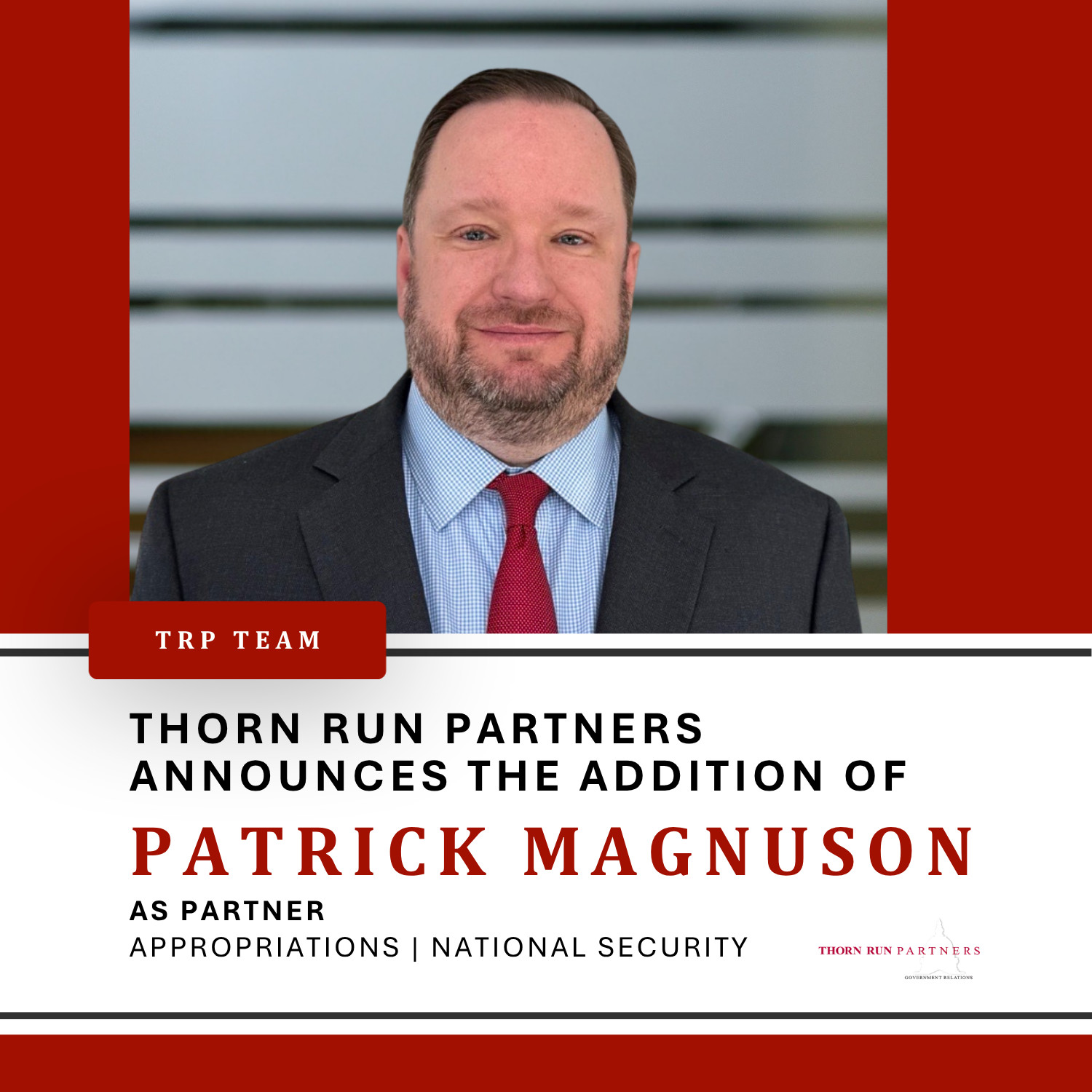
Thorn Run Partners Adds Veteran Senate Appropriations Subcommittee Staff Director Patrick Magnuson as Partner

Magnuson brings more than 25 years of congressional experience and deep expertise in appropriations, national security, defense, military construction, and veterans affairs.

For Immediate Release: September 9, 2026 

Contact: Andrew Rosenberg, (202) 247-6301 (arosenberg@thornrun.com) 

WASHINGTON, D.C. — Thorn Run Partners (“TRP”), one of the nation’s leading bipartisan government affairs firms, announced today the addition of Patrick R. Magnuson as a Partner, further strengthening the firm’s appropriations and national security capabilities.

Magnuson joins TRP with more than 25 years of experience on Capitol Hill, most recently serving as Majority Staff Director of the U.S. Senate Appropriations Subcommittee on Military Construction, Veterans Affairs, and Related Agencies. In that role, he led the development of annual funding legislation supporting military construction projects around the world and the U.S. Department of Veterans Affairs.

Throughout his Senate career, Magnuson worked closely with Senate leadership, committee members, House counterparts, and Administration officials to advance complex funding and policy priorities across defense, veterans affairs, and other national security accounts. His extensive experience navigating the congressional appropriations process will further enhance TRP’s ability to help clients understand and engage effectively on federal funding and policy decisions.

Before becoming Staff Director, Magnuson served as a Professional Staff Member on the Military Construction, Veterans Affairs, and Related Agencies Subcommittee, where he analyzed military construction accounts across the Department of Defense and other national security agencies and advised the Chairman and committee members on funding priorities. Earlier in his career, he served as Legislative Director to then-U.S. Senator Mark Kirk of Illinois, managing the Senator’s Washington legislative operation and advising on appropriations and national security matters.

“We are thrilled to add Patrick and his enormous institutional knowledge to the value we currently provide our clients, both within our national security practice and without. The appropriations process has never been more important, and Patrick is among the most respected experts in the city,” said TRP Co-Founder Andrew Rosenberg.

“I’m fortunate to have spent the last 25 years in a variety of positions on Capitol Hill working with and learning from dedicated and knowledgeable people. No matter how Congress changes, enacting appropriations will always remain its core responsibility and I’m excited to bring my experience to such a dynamic firm and their clients ,” said Patrick Magnuson.

Magnuson began his career on then-Congressman Kirk’s first campaign for Congress in 2000 before joining his congressional office in 2001. He holds a bachelor’s degree from Syracuse University and a master’s degree in national security and strategic studies from the U.S. Naval War College. He was selected for the John C. Stennis Congressional Staff Fellows Program for the 118th Congress and has received multiple public service honors, including awards from the Departments of the Army and Navy and Disabled American Veterans.

His addition continues Thorn Run Partners’ strategic growth across key practice areas and expands the firm’s depth of experience in appropriations, defense, veterans affairs, and national security policy.

About Thorn Run Partners 

Founded in January 2010 by veteran lobbyists Andrew Rosenberg and Chris Lamond, who previously served as staffers to Senators Edward M. Kennedy (D-MA) and Fred Thompson (R-TN), respectively, Thorn Run Partners is a full-service government relations, policy, and strategic communications firm with offices in Washington, DC, Portland, OR, and Los Angeles, CA. It has been recognized as a Top 10 lobbying firm by respected publications including Politico, The Hill, and Bloomberg, and ranks among the nation’s most creative and effective government relations firms.  

Pop-up-header-V1

Stay Ahead of Federal Policy

Subscribe to our TRP Tip Sheet!

Get timely analysis, firm updates, and strategic perspectives delivered straight to your inbox.